
Today I drove a couple of kilometers, five or six, I think, to the place called Palera, and took a walk by the sea.

I searched for insects, and I found some. That means you'll see plenty of macro photographs in this post. The scenery always looks good or great in that area, so I took a few wide shots as well.
I parked near one of the abandoned buildings of a former military base that appeared a few days ago in one of my recent posts and then walked across the meadows to the sea.

On the unpaved road, not far from my parked car, I saw this beautiful bird, the Upupa epops, commonly known as the Eurasian hoopoe.

By the side of the road, on the dry remains of the Scolymus hispanicus plant, I found a well-camouflaged shield bug.
The insect is barely recognizable in this and the previous shot. The bug is nicely hidden in the hollow that once hosted a flower and then the seeds.

With a little incentive from my forefinger, the shield bug was convinced to leave that perfect hideout and pose on the dry, thorny leaves where it was visible enough for a fairly good portrait. The name of the species is Carpocoris purpureipennis. This isn't an adult. In all these shots you can see a 4th instar nymph.

A couple of meters from there, on the Verbena officinalis plant ...
... I found a group of much younger Carpocoris purpureipennis nymphs.

These tiny 1st instar ones have hatched very recently. They are still congregated around the cluster of empty eggs.
I find these baby shield bugs kind of cute.
While photographing the Verbena officinalis flowers ...
... I noticed something move in the center of one of them.

Here, especially if you enlarge the picture by clicking on it, you'll be able to take a relatively good look at the minuscule creature. This is a trip. A tiny insect from the order Thysanoptera. Can't tell you what species exactly is this.

After some more walking, fifty or sixty meters further ...
... I came across another dry Scolymus hispanicus plant ...
... and I found another group of immature Carpocoris purpureipennis bugs.
Most of them were 4th instar nymphs, the type of nymph you saw earlier in the post...
... but I also photographed one smaller 3rd instar among them. In the following photograph ...
... I came closer to that one.

About ten or fifteen minutes later, and a bit closer to the sea ...

... I saw the hoopoe again.

The bird was searching for food among the low vegetation five or six meters from the shore.

The Eurasian hoopoe eats a wide variety of things from insects, small frogs & lizards to seeds and berries.

Here you can see a fishing boat that was returning to the harbor of the nearby village of Liznjan. This type of boat hunts the sardines in the deeper water outside the bay.

I continued rambling through the grass and other herbaceous vegetation and at one point ...

... a few grasshoppers jumped before my feet so I crouched, mounted the macro lens again, and started sneaking around in the hope of photographing at least one of them.
It took me five or six minutes to get this portrait ...
... of a well-camouflaged Chorthippus biguttulus grasshopper. I felt lucky enough, but then ...

... I successfully approached another grasshopper.
In an environment made of an intricate mix of brown and green plant parts, the colors and markings of both grasshoppers provide a perfect camouflage.

The name of this second species is Aiolopus strepens.

Here you can see a little yellow detail hidden among the taller vegetation of the uniformly brown-green meadow - the flowers of the Lotus tenuis plant.

Half an hour later, on the same meadow ...
... I photographed another well-camouflaged grasshopper.

This is the small nymph ...
... of the pretty big migratory locust (Locusta migratoria).

On the way back to the car, I stopped by this natural floral arrangement made of two plants, the Eryngium amethystinum that provided the thorny greenish-violet parts, and the Picris hieracioides that added the lovely yellow flowers to the stylish mix. On one of those yellow flowers ...

... I photographed this bug from the Rhopalidae family.

It looks like some species from the genus Maccevethus of that family, but I'm not sure.
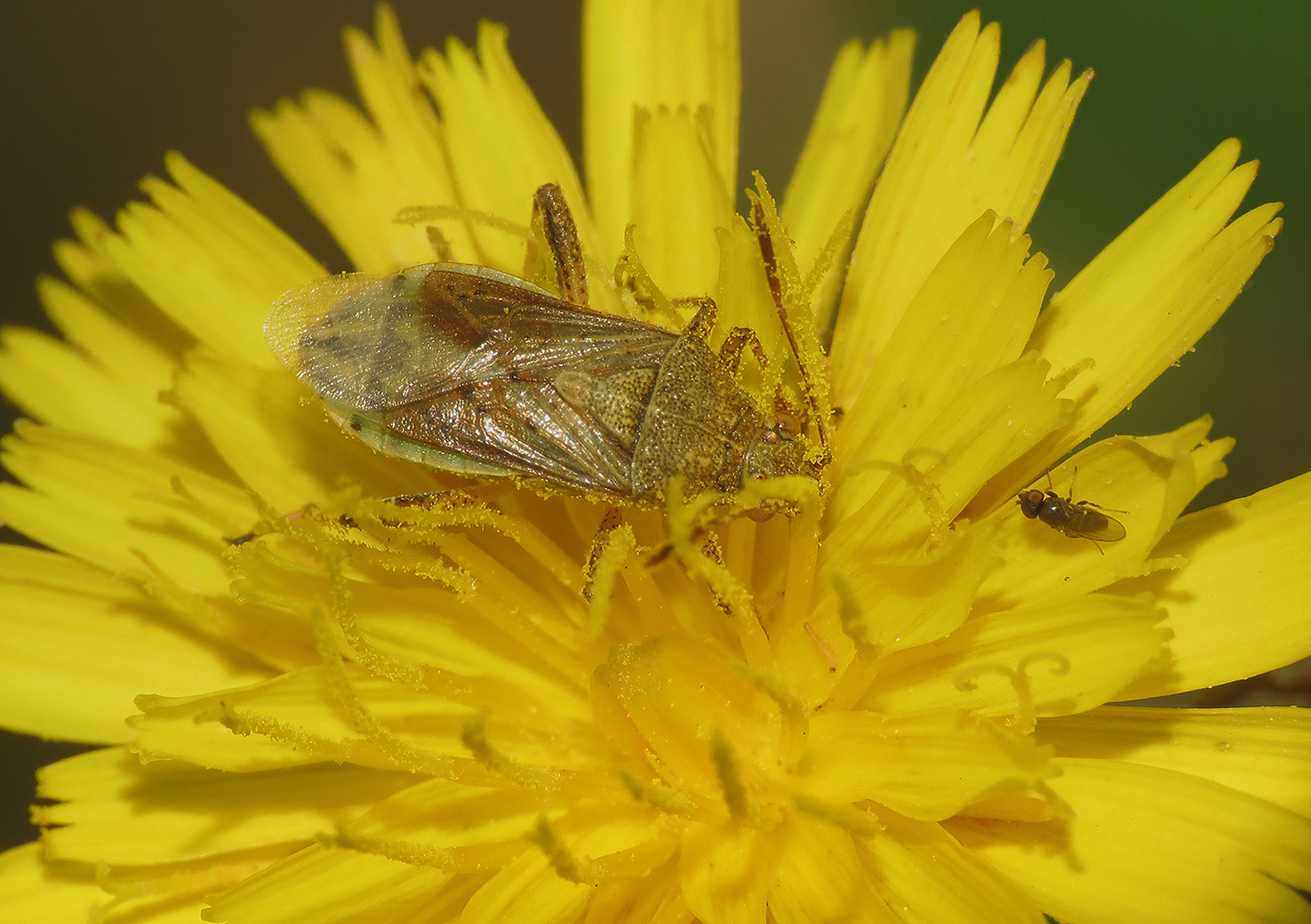
In this photograph, a tiny fy is posing next to the bug on the vivid yellow petals of the flower.
On another flower, very close to my car, I found this bee I wasn't able to identify. I think that it belongs to the Andrenidae family. But there is a good chance that I'm wrong. After photographing the bee ...
... it was time to go home.