
The hot summer days are pretty quiet here in my yard. The cats are sleeping. The lizards can be seen taking a sunbath on the garden wall. Only wasps and flies create a bit of buzz from time to time.
Later, at night, things remain silent, but there is much more movement going on, and some interesting creatures appear on the scene. In this opening shot, you can see a moth from the Geometridae family that came attracted by the lamp and landed for a minute on the front door of my house. The name of the species is Cyclophora puppillaria.
Here you can see one of my cats. A male that goes by the name of Farabuto has climbed the fig tree.
This antlion was photographed on that same tree. The scientific name of the species is Euroleon nostras.
Here you can see an interesting, ornate little moth from the Notodontidae family. The Spatalia argentina.
It looks pretty strange when seen from above. Strange in a lovely, fluffy way, that is.
This cat was photographed on the Lilac tree. It's a male. His name is Paltchich.
Here you can see another lovely moth from the Geometridae family. With quite a few similar green-colored species from this family present around, I can't say for sure which one exactly is this. It looks a lot like the Thalera fimbrialis. But not exactly like that species. Some details are different. I don't know. Geometridae can be a confusing family.
The Erinaceus roumanicus hedgehogs are regular visitors in my yard and garden. Some of them, maybe, reproduce and hibernate in hidden corners of the area around my house. Sometimes I encounter young hedgehogs that are sniffing and exploring around.

I considered them almost like some kind of nocturnal pets ...
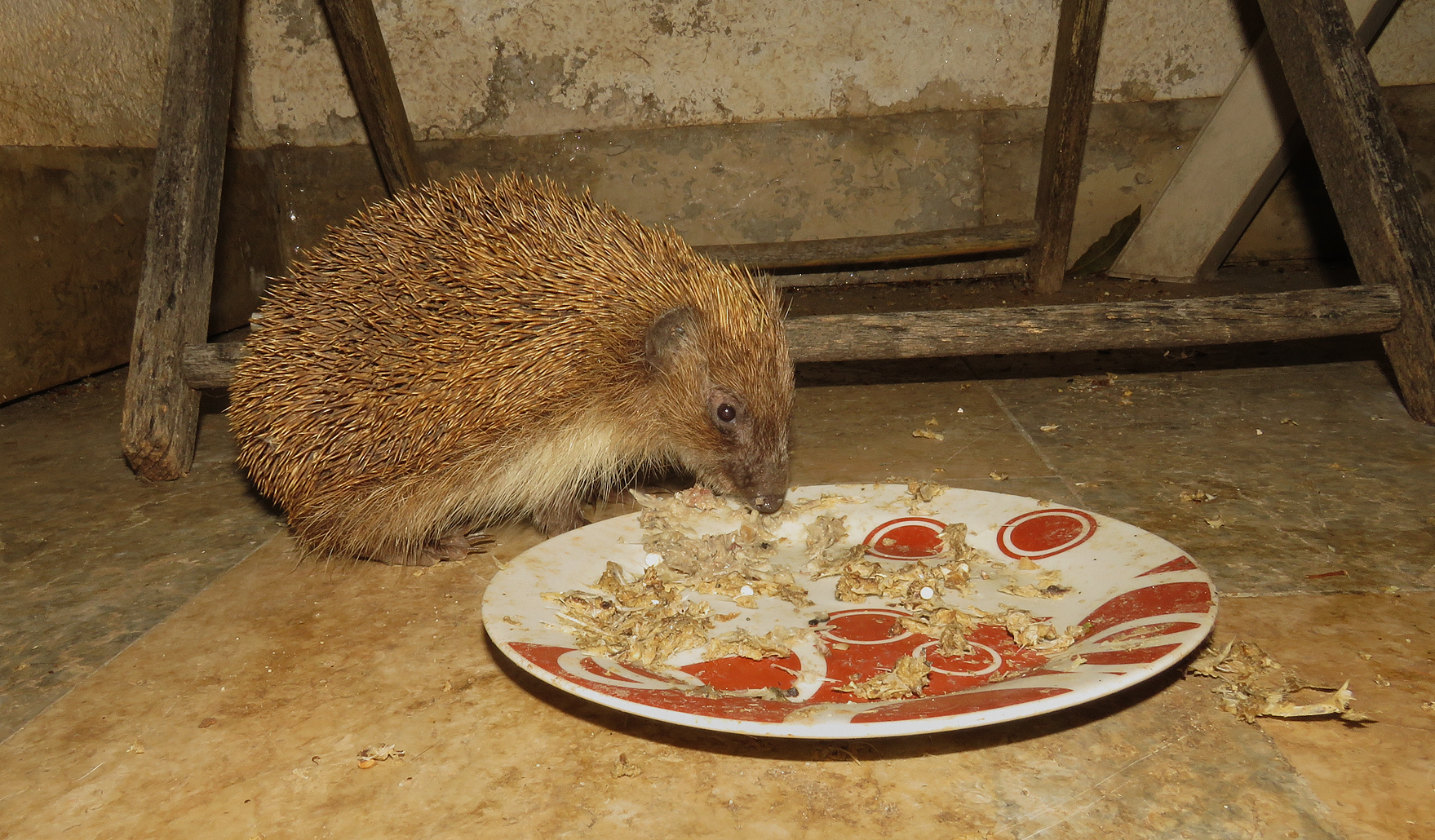
... and just like real pets, they often share the dish with my cats.
It seems that the dish is sometimes too small and shallow for a healthy hedgehog appetite ...
... so they straighten up and get on their hind legs to continue the dinner with the stuff inside the pot.
A hedgehog is extremely cute in this pose.
The slugs are also attracted by the cat food.
Usually, they enter the dish when everything is quiet. When the cats and hedgehogs are done with dinner.
And they clean up the remains.

Here you can see a well-fed, satisfied slug leaving the dish at a snail's pace.

On one occasion I stumbled upon this fairly funny scene involving cats and slugs. The Deroceras reticulatum slug was eating from the dish, while the cat called Malatz was eating from the nearby pot. All the slugs in this post are Deroceras reticulatum slugs.
Here you can see yet another moth species. From the Erebidae family this time. This is the Phragmatobia fuliginosa.

This wolf spider was caring its offspring around. What looks like a series of strange protuberances on its abdomen are young spiderlings. This is the Trochosa ruricola female.
This is the Horisme vitalbata, another species from the large and varied Geometridae family.
The Chrysoperla carnea, commonly known as the common green lacewing, is a prevalently nocturnal insect that can be often found on the aphid-covered plants in my garden. The adults feed on nectar, pollen, and honeydew produced by aphids. The larvae are predators that feed on aphids and other very small insects.
The moth shown in this photograph belongs to the Erebidae family. This is the Eilema caniola. The larvae of this species have a fairly unusual diet. They feed mainly on algae, especially on green films of Pleurococcus, and on a variety of lichens that grow on rocks. Less often, they can be also seen feeding on flowers of the plants from the genus Genista, Lotus, and Trifolium in the Fabaceae family.
This small spider has found its hunting corner on my house facade, just above the front door. The ant species present in my yard and garden often release their winged, reproductive kings and queens at dusk or during the night. In this photograph, one of those winged ants ended up caught in the spider's web.
In this case, I wasn't able to identify the spider. Nor the ant.
In this and the following photograph, you can take a look at two species from the Noctuidae family.
Two species that I wasn't able to identify.
And that's practically it.

With a few more funny hedgehog shots, is time to end this nocturnal summer post.

The following links will take you to the sites with more information about some of the animals shown in the post. I found some stuff about them there.
https://www.leps.it/
https://www.inaturalist.org/check_lists/1541524-Spiders-of-Croatia?page=1
https://en.wikipedia.org/wiki/Northern_white-breasted_hedgehog
https://en.wikipedia.org/wiki/Deroceras_reticulatum
https://en.wikipedia.org/wiki/Eilema_caniola
https://en.wikipedia.org/wiki/Chrysoperla_carnea
https://en.wikipedia.org/wiki/Phragmatobia_fuliginosa
HOPE YOU ENJOYED THIS NOCTURNAL EXPLORATION OF MY YARD. AS ALWAYS HERE ON HIVE, THE PHOTOGRAPHS ARE MY WORK.