
On the contrary to most of my posts, this one I'll start with a video, and add a little explanation story.

Here is the video, check it out and think a little about it. Why the more things are popping up and what is this? Very slowly at first, but they tend to pick up speed as time goes by. What do you think, why?
You have all probably heard, but I'll start with it anyway, absolute zero. It is a theoretical temperature point at which all things stop moving, and it is at exactly zero Kelvin [0 K] or, something more familiar -273.15 ˙C and it's a crazy negative amount in Fahrenheits close to 451. :)
Now, what do we know about the temperature, what is it? Is it just the number we check-up and know it is cold or hot - and what it represents? what does it measure?
What is the coldest temperatures reached on Earth and what is in space? Hottest? Why do things keep expanding on heat and contracting when it is cold? (well, basically everything except water).
These are some of the questions, I'll try to give you an answer, or kinda get you interested to do your investigation - respected reader.
Let's try with the first one - What is Temperature?
By the definition, the temperature is a measure of the average kinetic energy of the atoms or molecules, what does it mean - it tells us information about the energy of little particles inside of a body/container, the local part of the Earth's atmosphere.
Now, if you take a thermometer, I'll go with the old ones filled with mercury. mercury is trapped in a small spherical container at the base and the capillary(very narrow) tube made of glass. As the mercury changes temperature, it expands or contracts at a much greater rate than its container - glass in this case. With higher temperatures, particles have more energy and move chaotically, as a consequence in our little thermometer - the mercury expands, the force exerted by the mercury on the capillary walls increases, and the mercury starts going up - the narrower the tube mercury will go faster up - until it reaches the equilibrium point between the capillary force and gravitational force that is pulling mercury down.


So, what is the coldest temperature in Space? Pick a guess...
For years it was known as Cosmic Microwave Background Radiation (CMB) at 2.73K which is relic radiation from the Big Bang, but several years ago Boomerang Nebula smashed this record with measured temperatures of -236 degrees Celsius or 1.15 Kelvins.
While on Earth it was managed to drop the temperature of a metal piece to the amazing
0.00036 K, more about that in this article in Nature.
Why do we chase these temperatures? Well... At extreme points of nature usually, extreme things happen. One of the well-implemented phenomena in the real world is something called superconductivity - where materials cooled down just enough can conduct the electricity without resistance and superb efficiency. The same method is used for levitation trains - MagLev.

In astronomy, we use cryogenic coolants such as Liquid nitrogen for most of the optical telescopes and the state of the art instruments use liquid helium, both on Earth and in space. Why? Infrared and radio receivers are very sensitive, and it is a big problem in astronomy, especially Earth-based. Infrared - all bodies with some internal heat emit infrared radiation. While radio is picking up all the signals from Bluetooth, wifi, mobile phones, tv, satellites, communications pick anything... static noise from Earth, everything around the receiver is noise. Liquid He can cool the receiver between down to 10-20K and we still get a lot of noise.

Now, back to our video, why do small bubbles start moving faster, as time goes by?
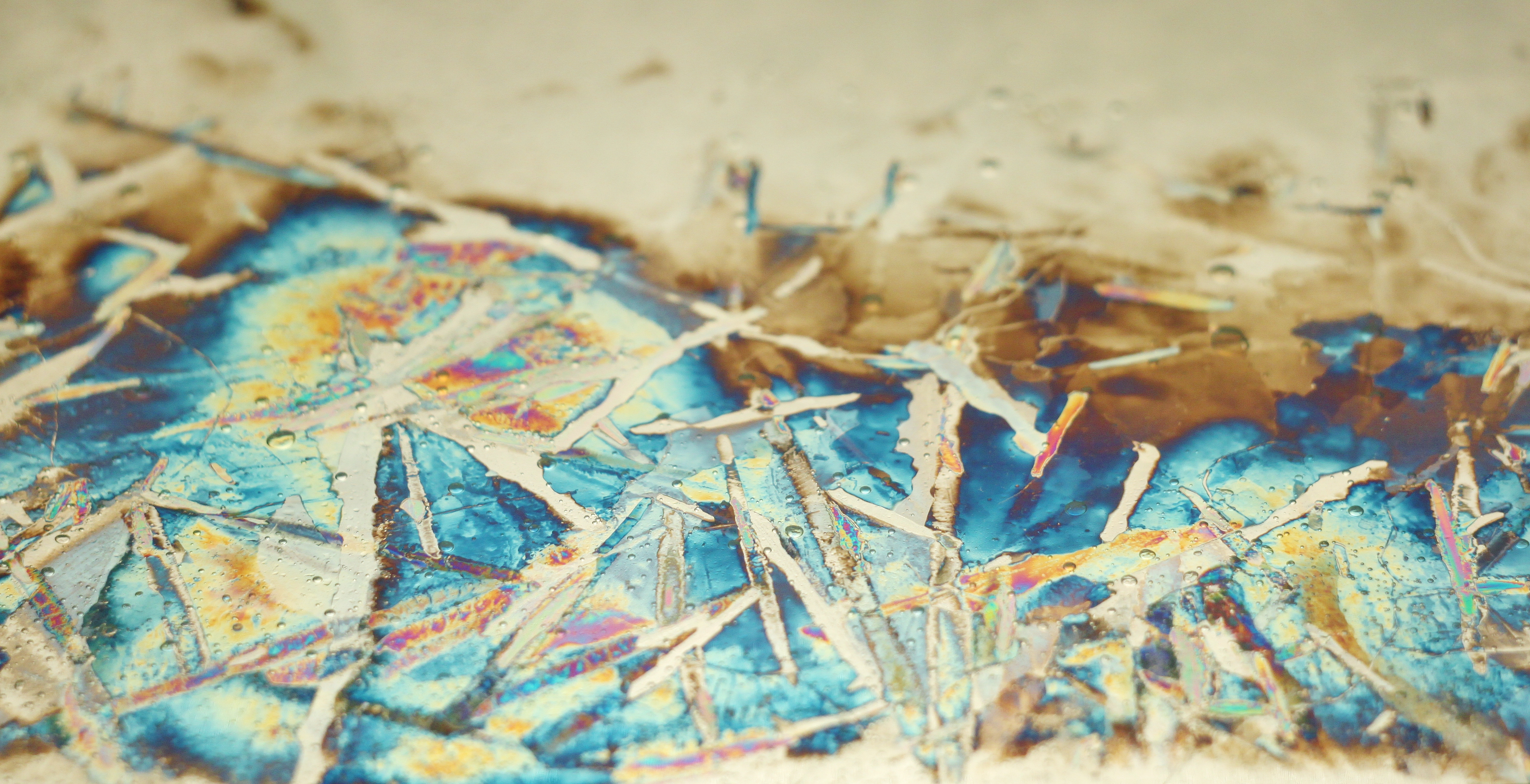
First of all, it is air (gas), trapped inside the ice. as it is cold and below zero the things are moving very slowly, as the temperature rises - ice starts to melt, and the crystal structure(picture above) starts to break down, the gas is released. Towards the end, you can see a lot of small bubbles swirling around, as well as the large ones still trapped but vibrating back and forward.

Hope you find this post interesting, and if you do feel free to comment, start a discussion, make your post about it, express your interest in similar things or whatever comes to your mind.
I might continue writing for a next post about the Boomerang Nebula and CMB temperatures.
That's all for now!
All photos are mine, © Svemirac.
Co-founder of Crowdmind project.
CEO of @Curie.
Curie witness and crowdwitness operator.
If you happen to have some free witness votes, don't be shy to approve these, we are ranked as 63rd and 13th respectively.