
When it comes to small arthropods, insects, spiders, and such, you can find plenty of them in my garden. For me, they are as if not even more important than the fruits and vegetables I grow. Is great to have something interesting to observe and photograph through the macro lens on a day when you don't feel like walking or driving far for a macro safari.

The narrative of each of the previous episodes revolved around one specific plant. In this last one, the narrative will be slightly different, definitively looser, a summer mix that includes a bit of zucchini and a few tomatoes.

Here you can see a small fly resting on the yellow surface of the tomato fruit. The tomatoes in my garden were changing color exactly like the traffic light while ripening, they were going from green to red passing through a short yellow phase.
When it comes to the fly, I can't tell you what species is this. By the shape of the wings, I would say it belongs to the Lauxaniidae family but there is a good chance I'm wrong. I don't remember seeing this type of fly before this summer. It has some similarities with the tiny Drosophila melanogaster fruit flies but there are some differences too, and most importantly, this species is much bigger.

Here you can see a group of tomatoes that includes one green, one yellow, and quite a few red fruits.

In this photograph, you can admire one of my showy zucchini plants with large leaves and lovely flowers.

Here I came closer to the young fruits. One of them still has the remains of the flower on its top. In the following photograph ...

... you can see a pretty big fruit ready to be picked, cooked, and eaten.

The upper surface of some zucchini leaves was covered with mildew ...
... and the Psyllobora vigintiduopunctata ladybeetles, both larvae, and adults, were grazing that white fungal powder.

I came closer to the larvae in this shot.
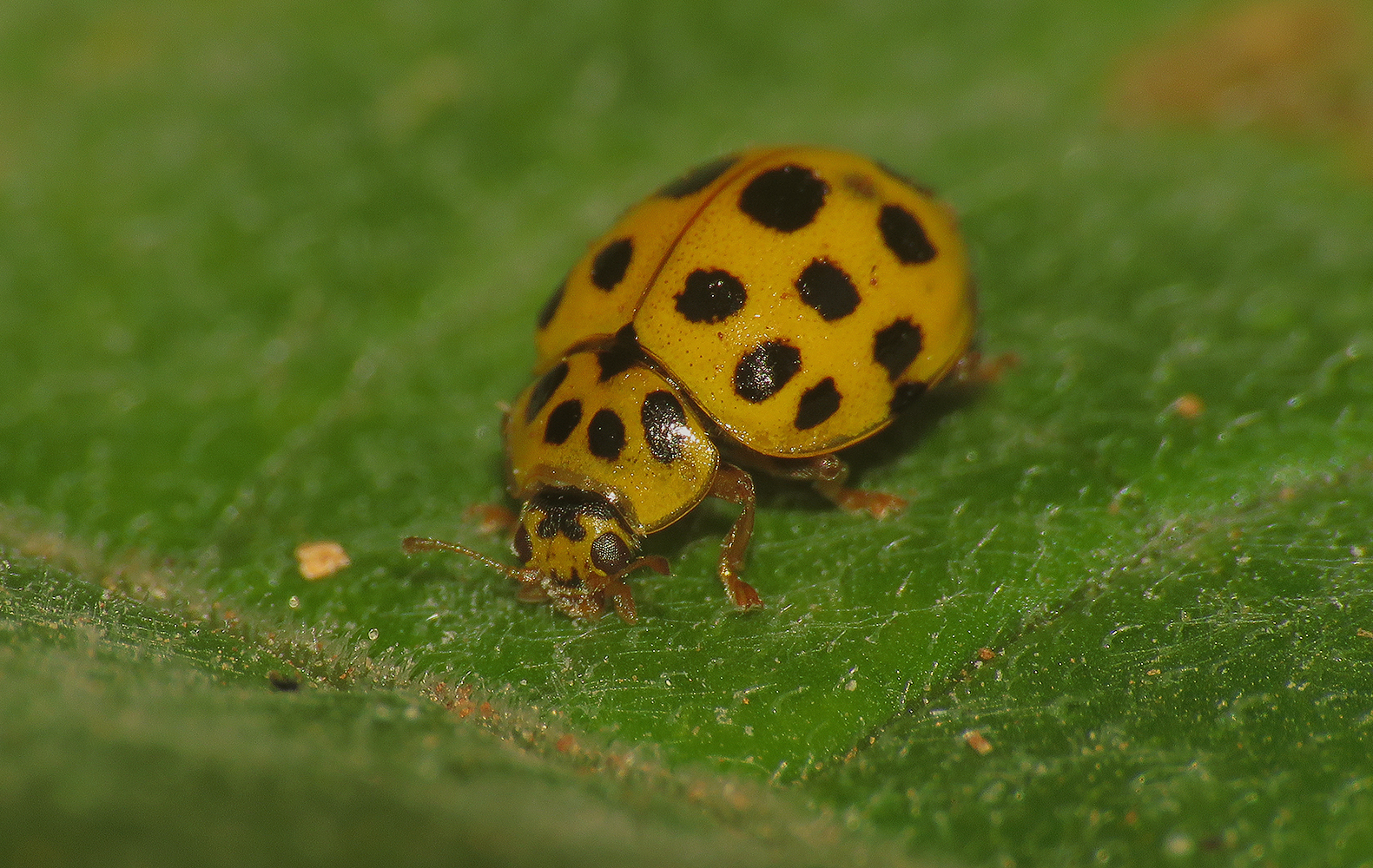
Here you can see an adult beetle feeding on mildew. In the following photograph ...

... I used the full power of my Raynox DCR-250 Macro Lens to get even closer to a patch of mildew.

This Psyllobora vigintiduopunctata adult was photographed on the leaf's underside where mildew doesn't grow.

The veins on that side form beautiful, very artsy-looking structures when lit in the right way.
I found some very small insects while exploring the other side of a zucchini leaf. Here you can see a whitefly. Trialeurodes vaporariorum is the name of this species from the Aleyrodidae family.
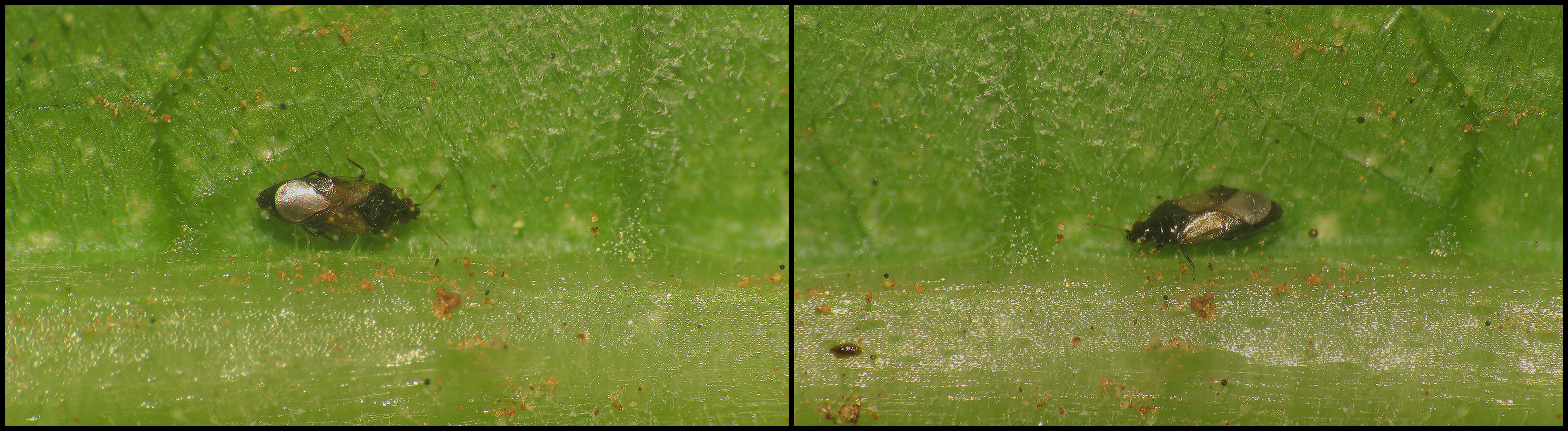
This tiny bug that hunts other insects of the same or similar size belongs to the Anthocoridae family. The name of the species is Orius insidious.

Here you can see a tiny ladybeetle larva I wasn't able to identify. It could be a very young, recently hatched Psyllobora vigintiduopunctata. That's also possible.
In this photograph, the Plagiolepis pygmaea ant is traveling across the interesting macro landscape situated on the lower side of the large leaf.

You can see another group of tomatoes here.

On the first of September, I photographed a jumping spider on one of those fruits.

Here you can see the same spider with a mosquito in its fangs.

The name of the species is Evarcha jucunda. The family is Salticidae, of course.

This is a female. Males have a significantly different appearance.

At one point, the spider jumped away, and then ...

... a couple of minutes later, returned with a prey.

The mosquito that the jumping spider caught ...

... is one of the Aedes albopictus males that were feeding on the overripe fruits fallen from the nearby fig tree.
Here you can see the spider finishing the mosquito in an upside-down position on the opposite pole of the little red tomato-planet. In the following photograph ...

... Evarcha jucunda is cleaning its feet after the meal.

In this shot, the focus is on the zucchini plant again. In the following photograph ...
... I came closer to one of its male flowers.

Here you can see the remains of the female flowers on the ends of the immature fruits.
When I came closer to one of those folded flowers I noticed some red grains on it.

Can't tell you what these tiny things are, some insect droppings perhaps, but in macro view, they surely look good.

Here you can see a minimalist composition with just one little red dot in the center of the shot. In the following photograph ...
... you can see another male flower, and then, in the next picture made of two photographs taken a day or two later ...

... you can see a pollinator entering and exiting the same flower. Bombus terrestris is the name of this very common bumblebee species.

On some leaves, the mildew was very dense.
It looked like snow when seen through the macro lens.

Here you can see a Psyllobora vigintiduopunctata larva grazing in the "snowy" macro landscape. In the following photograph ...
... you can see an adult beetle on the same pasture, and then, in the next two shots ...
... you can see a pair mating.
The female was grazing while the male was trying to keep the balance on her back.
On one of the mostly brown, almost completely dry leaves ...

... a snail was resting sealed inside its spiral shell. Since I don't know what species is this, the only thing I can say here is that these snails are active at night.

Here you can see the Psyllobora vigintiduopunctata larva feeding on the dry part of the leaf.

It was the fifth of September when I photographed this Psyllobora vigintiduopunctata pupa on another partially dry zucchini leaf. When the metamorphosis is done, an adult beetle will come out of this thing.

This is yet another portrait of an adult Psyllobora vigintiduopunctata ladybeetle.
You can see another larva here. This one was photographed in a different light.

On the second day of September, always on the leaves of the zucchini plant ...

... I photographed the beautiful Harmonia axyridis ladybeetle. When this and the previous photograph were taken, the beetle was quiet on the lower surface of the leaf.

Here you can see the same beetle walking.

When these two shots were taken, the beetle was ready to fly away.
Here you can see a few clusters of cherry tomatoes.
The small flowers shown in this photograph ...

... belong to Heliotropium europaeum, the poisonous plant that grows as a self-seeding weed near tomatoes.
The hairy inflorescences, small but decorative, look a bit like tentacles. It's a beautiful plant.

This pretty big bushcricket ...

... was photographed among the dry foliage of the tomato plant.

The name of the species is Eupholidoptera schmidti, it belongs to the Tettigoniidae family.

You can see another one in this shot. The long, saber-like ovipositor is visible so I can confidently say that this Eupholidoptera schmidti is a female. The gelatinous material attached to the insect's abdomen is called spermatophylax. That edible and very nutritious thing is produced by males who use it as a nuptial gift for females to deliver after mating.
Here you can see the Pieris rapae butterfly resting on the unripe tomato. In the following photograph ...

... you can see a caterpillar on the tomato leaf, a caterpillar I wasn't able to identify.

It looks like a moth larva.

Maybe one day I'll be able to tell you what moth or butterfly this larva will turn into. For now ...
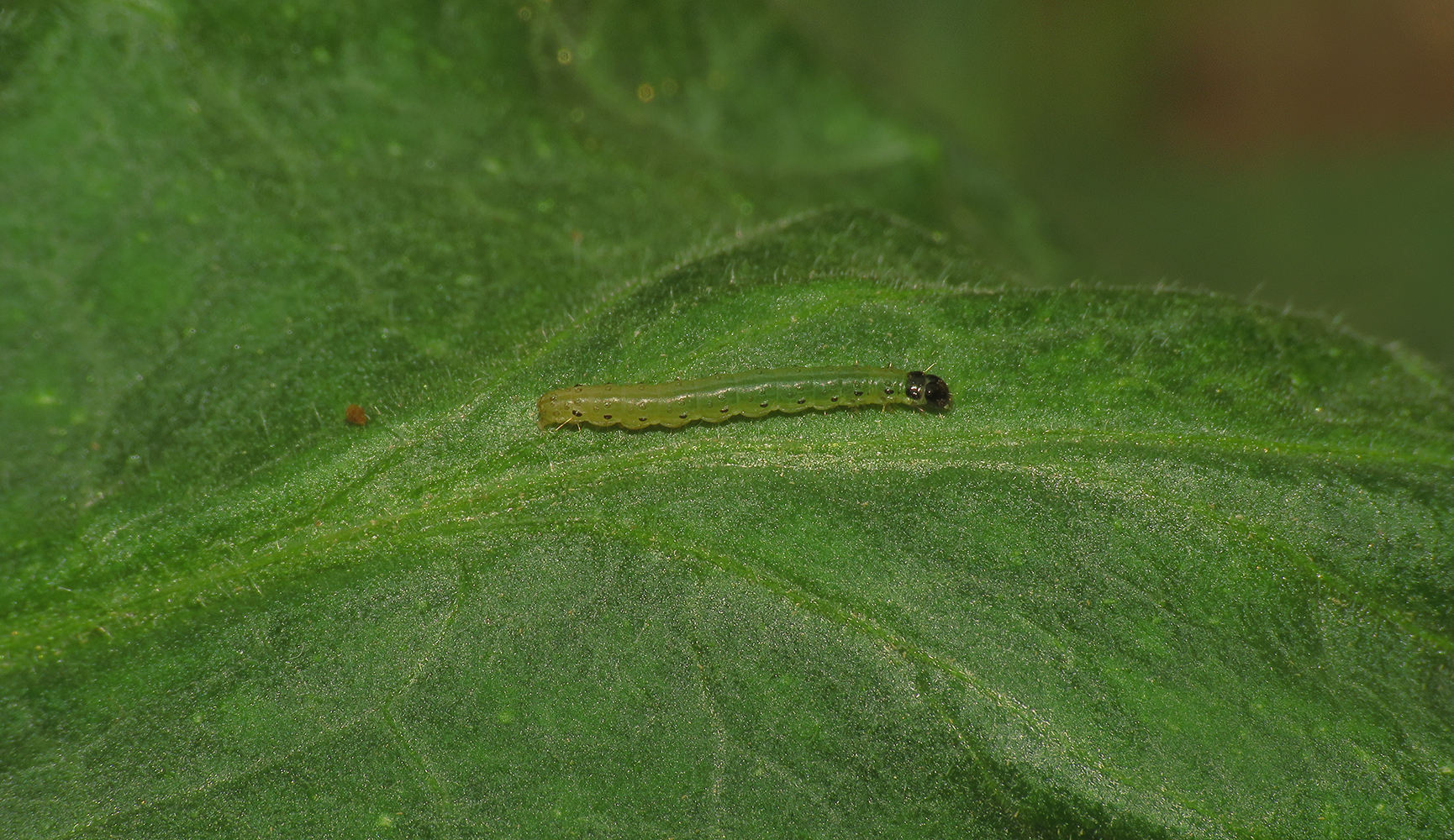
... as far as this post is concerned, that's still a mystery.
In this and the following two photographs ...

... you can see a pretty big fly from the Sarcophagidae family posing on the green, unripe tomato. The name of the species is Sarcophaga carnaria.

Here you can see the similar-looking Voria ruralis fly resting on the upper, mildew-covered surface of the zucchini leaf. This species belongs to the Tachinidae family.
Here you can take yet another better, more up-close look at the mildew.
Whenever I mention the mildew, you can be sure I'll show you some Psyllobora vigintiduopunctata soon.

When I see a group like this feeding on mildew I can't avoid the comparison with a small herd of sheep grazing on the green pasture. In the following photograph ...
... the focus is on one single larva from the group shown in the previous shot.
This larva was photographed on a different occasion and in ambient light.
Here you can see another adult.
This is the Monosteira unicostata ...

... a bug from the Tingidae family. I wrote more extensively about this species in the previous episode of the series, the one called ALL AROUND THE CHERRY TREE. The interesting thing about the Monosteira unicostata shown in this, the previous, and one of the two following photographs is its pale appearance.

Here you can compare it to the typical, brown-colored Monosteira unicostata.
Both insects were photographed on the upper surface of the zucchini leaf.
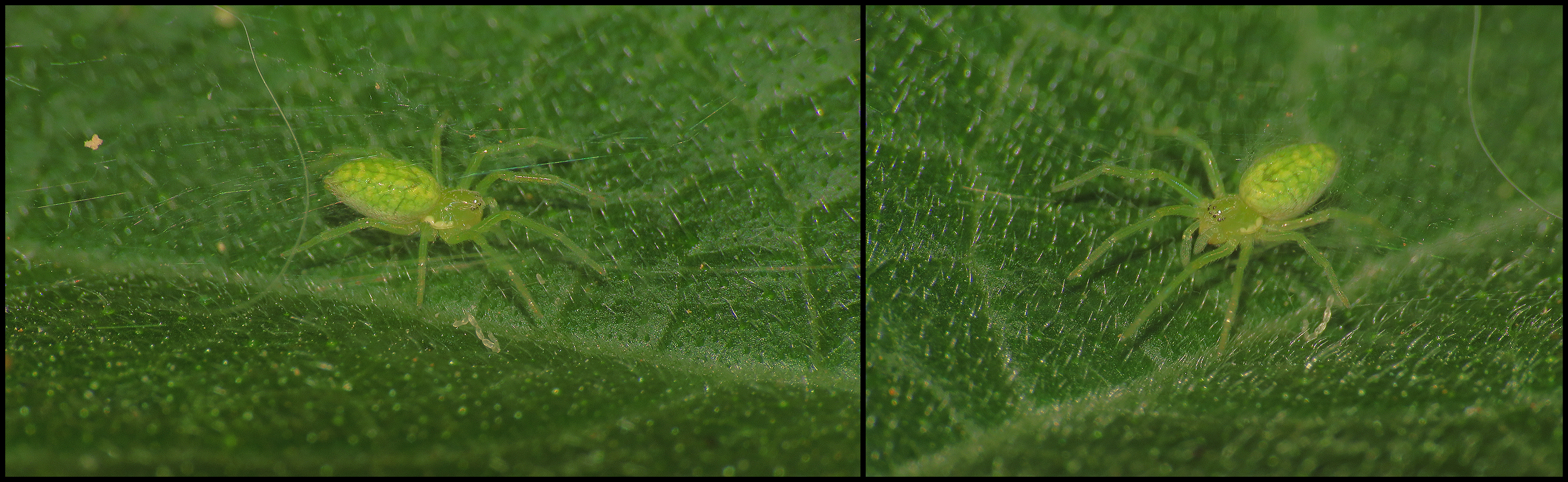
This tiny spider was well-camouflaged on another leaf of the same kind. The name of the species is Nigma walckenaeri.

Here you can see the nymph of some predatory bug from the Nabidae family. Can't tell you the name of the species.
Here you can see the second big, juicy, completely matured zucchini fruit of this post.

Here you can see more mildew on the zucchini leaf. The mildew shown in the following photograph ...
... grows on young leaves and leaf buds of the Chenopodium album plant.
This shot was taken in ambient light. The white powder is more pronounced that way. Chenopodium album is an edible self-seeding weed that grows among the cultivated plants in my garden.

This fly from the Syrphidae family was photographed on one of the leaves situated lower part of the relatively tall Chenopodium album plant. The name of the species is Episyrphus balteatus. The much smaller fly, shown in the following photograph ...
... was resting on one of the leaves near the top of the plant. I don't remember seeing this iridescent species before this summer. The family is probably Lauxaniidae, that's all I can tell you about this insect.
Most of the ripe tomato fruits in my garden were proudly hanging like some lovely communist-red Christmas balls on the plants that produced them. In this shot, you can see a couple of heavy ones that have reached the ground.

Here you can see the Cacyreus marshalli butterfly resting on the red ripe tomato. In the following photograph ...

... another butterfly of the same species is resting on one of the fresh, green leaves of the tomato plant. Cacyreus marshalli belongs to the Lycaenidae family.

Here you can see a fifth instar nymph of the southern green shield bug (Nezara viridula).

At this stage of its life, the insect is nicely camouflaged on the mix of green, brown, and yellow typical for the decaying foliage.
AND THAT'S IT. WITH THIS NYMPH THAT WILL SOON TURN INTO A WINGED ADULT SHIELD BUG, IS TIME TO END THIS POST AND THE ENTIRE SERIES. HOPE YOU ENJOYED THE SUMMER REPORTS FROM MY GARDEN IN THE HOT SUMMER OF 2023. AS ALWAYS HERE ON HIVE, THE PHOTOGRAPHS ARE MY WORK.
If you wish to visit the previous episodes, the following links can take you there.
@borjan/summer-in-my-garden-episode-one-a-colorful-introduction-with-lady-beetles-and-tomatoes
@borjan/summer-in-my-garden-episode
@borjan/summer-in-my-garden-episode-eb464586eb8b4
@borjan/summer-in-my-garden-episode-a8321a81cdf9a
@borjan/summer-in-my-garden-episode-five-all-around-the-cherry-tree
I have a few more links for you before the definitive end. These will take you to some sites with more information about some of the protagonists of today's post. I found some stuff about them there.
https://en.wikipedia.org/wiki/Lauxaniidae
https://en.wikipedia.org/wiki/Greenhouse_whitefly
https://en.wikipedia.org/wiki/Orius_insidiosus
https://en.wikipedia.org/wiki/Psyllobora_vigintiduopunctata
https://en.wikipedia.org/wiki/Evarcha_jucunda
https://en.wikipedia.org/wiki/Harmonia_axyridis
https://en.wikipedia.org/wiki/Heliotropium_europaeum
https://www.orthoptera.ch/arten/item/eupholidoptera-schmidti
https://en.wikipedia.org/wiki/Pieris_rapae
https://en.wikipedia.org/wiki/Sarcophaga_carnaria
https://en.wikipedia.org/wiki/Voria_ruralis
https://ukrbin.com/index.php?id=2822
https://en.wikipedia.org/wiki/Nigma_walckenaeri
https://en.wikipedia.org/wiki/Nabidae
https://en.wikipedia.org/wiki/Geranium_bronze
https://en.wikipedia.org/wiki/Nezara_viridula