
Vesta Approaches Earth
Rendered view (in Blender) showing the comparative size of earth and Vesta. You will notice the African continent and part of Europe in the image. Although Vesta is shown here hovering 500km of the surface of the earth, in reality, it can never get closer than 172 million km from us. 3D data credit: Doug Ellison / NASA-JPL
Vesta, one of the largest asteroids is currently well placed for viewing and in fact if you know exactly where to look and you have access to a dark sky you might even see it with the naked eye. Although technically bright enough to see with the naked eye, binoculars are far better for seeking out the asteroid. Don’t expect to see anything more than a star though, although it’s kind of cool to be able to say you saw a dwarf planet with your own eyes!
During July, it slowly fades but continues to be visible in binoculars, not too far from the planet Saturn in the sky. If you're interested in finding the asteroid, I’ve included the asteroid's path in the photograph below.
Vesta was recently visited by the DAWN spacecraft which showed that it is 525km in diameter and somewhat oblate in shape. Apart from a large number of impact crater’s one of the more distinguishing features is the large trough’s that run approximately around the equator of the asteroid. These troughs are believed to have been caused by crust movement from the huge impact that caused the Rheasilvia crater at the asteroid’s south pole. Vesta is the second most massive asteroid in the asteroid belt (between Mars and Jupiter) but falls short of being called a dwarf planet.
Vesta in 3D. I used 3D data from NASA's DAWN mission to generate this rotational animation in Blender. 3D data credit: Doug Ellison / NASA-JPL
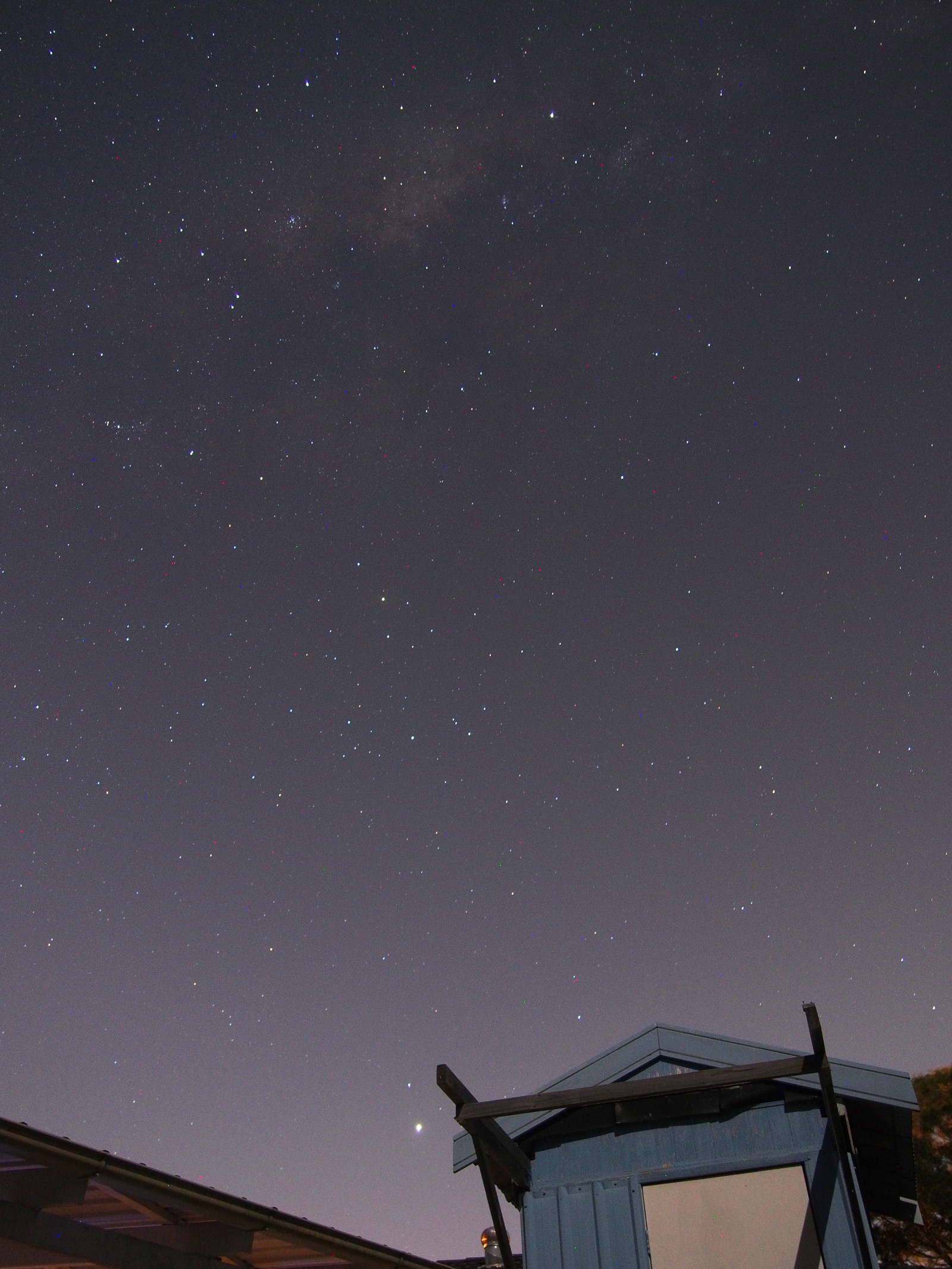
I was also able to easily detect Vesta just using my Olympus camera with its standard kit lens, with no extra equipment (apart from a tripod) just a few days ago. Setting the camera to manual mode, focal length to 14mm (the widest setting), focal ratio f4, exposure to 20 seconds I managed to capture the following shot. So if you don't have any luck finding in binoculars you might just succeed with a camera and wide angle lens. It may even be worth trying with a smartphone with a suitable long exposure app installed.
Jupiter, Saturn and Vesta are visible in this simple tripod photo. The constellation of Scorpius is marked and there is also a hint of the milky way visible. Click on image for a non-annotated version. For people wanting to find the asteroid, the red line shows the movement of the asteroid over the next month
Meanwhile Jupiter and Venus on a night of "Good Seeing"
Meanwhile, Jupiter was terrific, and at the time the moon IO was transiting the planet as well as leaving a shadow. The planet looked impressive even in live view on the computer screen. However, the real magic happens when you stack the images and process them through wavelet filters. Here is the result of stacking 8,450 images (!). Not only can you see a lot of cloud detail on the planet itself, but also some detail on the moon IO itself. For comparison, IO is similar to Australia in size.
The moon IO transit's the face of Jupiter. It's shadow appears on the right. This image was made using a Celestron C14 operating at a focal length of 7000mm.
Finally...
Things have been busy lately, and my time here on Steemit has been limited, but I hope you all enjoy this brief update on what I've been up to in astronomy. I've also been testing some new cameras recently so hope to post the results soon. I also plan to post some more on comets soon.
NOTE: All images are the authors unless otherwise noted.
SteemSTEM is a community project with the goal to promote and support Science, Technology, Engineering and Mathematics on the Steem blockchain. If you wish to support the steemSTEM project you can:
Contribute STEM content using the #steemstem tag | Support steemstem authors | Join our curation trail | Visit our Discord community | Delegate SP to steemstem