
EXPERIMENT WITH DIFFERENT STYLES OF PHOTOGRAPHY
What I so enjoyed about attending Southeaster Center For The Arts (Now The Creative Circus) in Atlanta, back in the early nineties, was the fact that I was able to experiment with every kind of photography.
My classes included:
- Fine art black and white 35mm shooting and darkroom printing.
- Fine art color 35mm shooting and darkroom printing.
- Color transparency and print 35mm shooting for art and events.
- Studio product and food photography and lighting techniques using a 4x5 camera and transparency film.
- Architectural photography using a 4x5 camera and transparency film.
- Landscape and nature photograph using all camera formats.
- Studio and location portrait photography using studio lighting and natural lighting, medium format and 35mm cameras, and black and white and color print film.
- Wedding photography techniques and lighting using medium format and 35mm print film.
- Street photography using 35mm black and white and color print film.
- Creating art images using only the darkroom enlarger and the subject matter (photograms)
- Art theory.
- The business of photography.
- History of photography.
- A photography internship. (Mine was with CNN in Atlanta, going on assignment with the staff photographers to photograph famous wrestlers and boxers, and also photographing them in the studio!)
All classes were taught by working professionals in their fields, so what we learned was immediately transferable to real-life photography careers. My classmates went on to be portrait and wedding photographers, food photographers, architectural photographers, corporate photographers and sports photographers. Each seemed to be able to focus on one area of photography that they loved to shoot. I alone became a generalist stock photographer, which suited me well, because I could shoot everything from lifestyle to studio or travel photography, and enjoy it all!
During my first semester at college, I was introduced to black and white photography, the ideal place to start because it was easier to learn about composition and lighting without the added complication of color which makes our images more complex!
Image ©Diane Macdonald. All Rights Reserved.
Click on the image to view full screen!
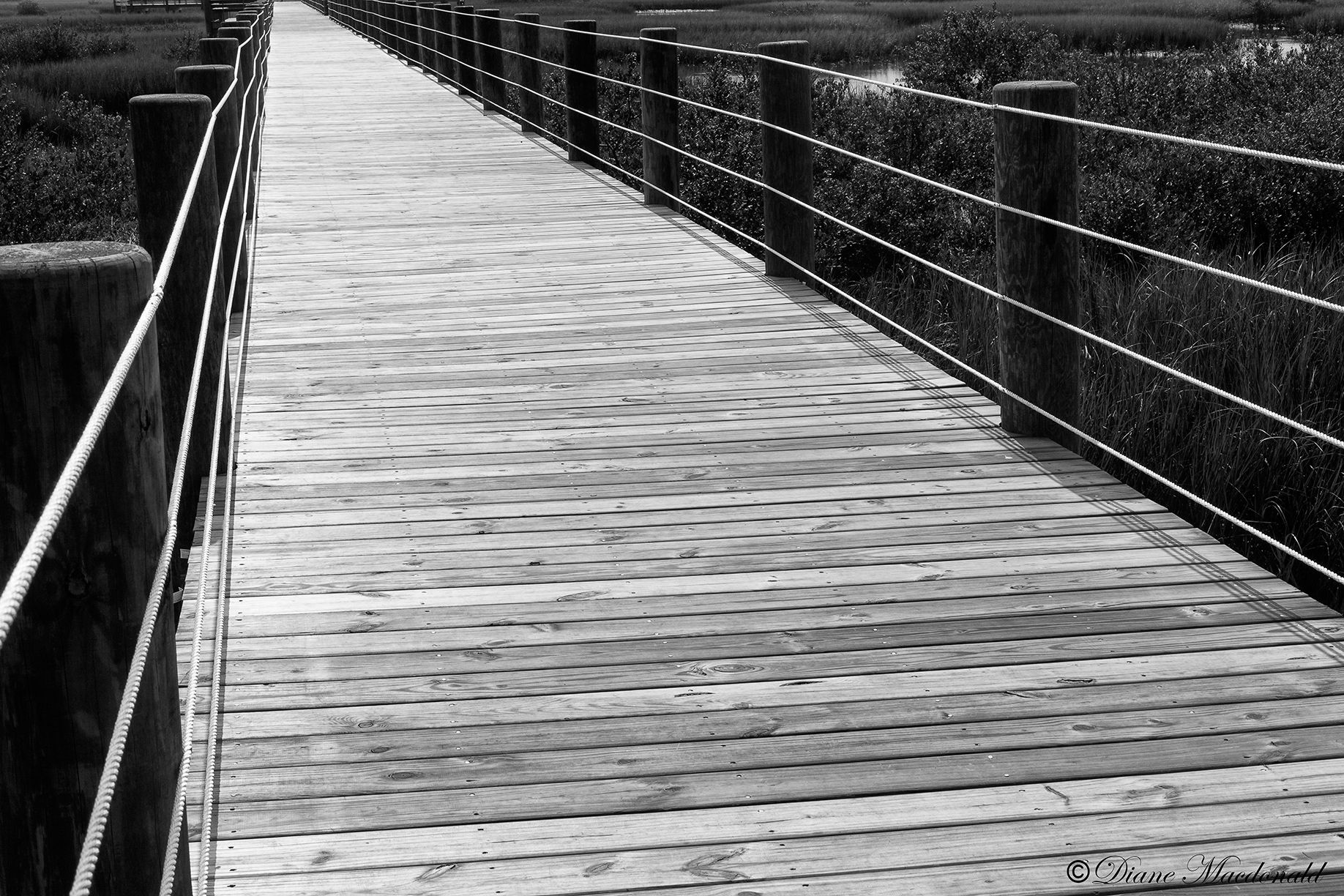
| Camera | Canon EOS 5D Mark II |
| Lens | EF50mm f/1.4 USM |
| Exposure | 1/320 sec; f/20; ISO 320 |
| Location | St. Augustine, Florida |
| Post-processing | Adobe Photoshop® CC 2017, Adobe Camera Raw, Nik Silver Efex Pro |
I don’t think there’s any such thing as teaching people photography, other than influencing them a little. People have to be their own learners. They have to have a certain talent.
– Imogen Cunningham
There is only you and your camera. The limitations in your photography are in yourself, for what we see is what we are.
– Ernst Haas
If I have any ‘message’ worth giving to a beginner it is that there are no shortcuts in photography.
– Edward Weston
So, if you are just starting out, you may want to concentrate on black and white for a while. You can set your smartphone or point-and-shoot camera to black and white and forget about it. If you have a DSLR camera, you may want to shoot in raw + black and white jpeg (and let the camera make some decisions for you.) I would not advise this for someone who is quite advanced in photography, because part of the thrill of black and white photography is having control over the output. You become like Ansel Adams, deciding which shadows and highlights need to be darkened and which need to be lightened. When you shoot with the camera's black and white setting, you have not participated in the artistic output, and the camera has made all the decisions for you.
Also:
- Experiment with portraiture and portraiture lighting both in a formal setting, and in an environmental setting.
- Experiment with high key lighting; Experiment with low key lighting.
- Experiment with setting up objects to shoot in a “studio” setting. You don't need to have an actual studio or fancy studio lights. There are countless lessons on the web explaining how you can achieve this. Use GOOGLE!
- Experiment with landscape and city photography. Shoot close up, then step back a few feet. Look up, look down, crouch down. Don't shoot everything at your normal eye level.
- Experiment shooting nature and other objects with a macro lens or the macro setting on your smartphone.
- Experiment with a wide angle lens for more than landscapes
- Experiment with the panorama setting on your smartphone, or use a tripod with your DSLR and stitch images together in Adobe Photoshop.
- Experiment being almost invisible and catching people in interesting street scenes.
Your first 10,000 photographs are your worst. Henri Cartier-Bresson
Experiment, experiment, experiment until you discover what it is you love to shoot. Don't worry if you can't decide on one thing. It doesn't matter! But in the process, you will have learned a few techniques along the way. No one says you have to shoot only landscape, or only people etc.
In fact, if you do concentrate on only one area of photography, you will be defined by it, and it will be hard for you to step outside of those constraints because of the expectations of others. Just think about actors who have been cast in a particular role. It's difficult for me to see Jack Nicholson as anything other than a bad guy. LOL!
Whatever you choose to do, remember:
What matters most is not what others feel about your photography, but about what photography makes you feel! - Diane Macdonald
My list in this series, including links to the subject matter already covered.
- Don't compare yourself with other photographers.
- Love what you do.
- Experiment with different styles of photography.
- Your photographs tell more about you than about the scene.
- Don't be an equipment snob.
- Focus more at first on good composition than on technical skills.
- Think of post-processing as the digital darkroom.
- Shoot what is in your own neighborhood.
- Flip the camera and take vertical shots.
- Even great photographers are remembered for only 1 or two GREAT shots in a lifetime.
- Avoid the SVS (Standard Vacation Shots) as much as possible.
- Use cloudy and rainy days to your advantage.
- Get up early.
- Capture city shots just after sundown.
- Travel light with camera gear.
- Don't be afraid to include people in travel shots.
- Photograph architecture with the full sun on the building front.
- Experiment with all kinds of software.
- Use on-camera flash on sunny days.
- Take many photos of one thing that excites you, and edit.
- Submit images with strong concepts to stock agencies.