
Surprising Creatures
Again, I am continuing with my series on extraordinary creatures of this planet. The last two editions have revolved around the oldest animals and the largest organisms. I would now like to turn to notably curious animals.
First example: Star-nosed mole
Image Source: GEO
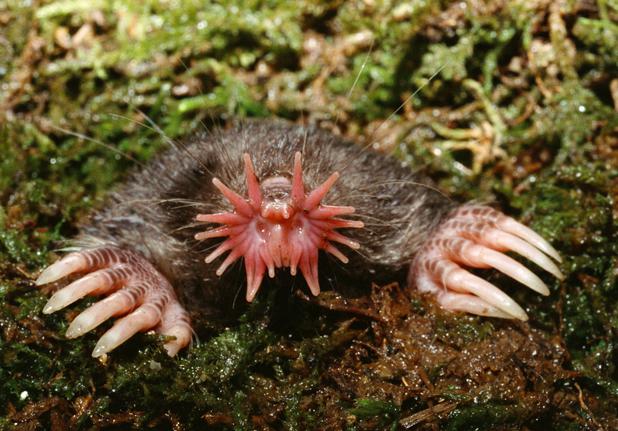
The star-nosed mole, or Condylura cristata, is a small mole, who lives in wetlands in the northern parts of America. He has the size of a hamster and a very special organ of perception, to which he owes his name.
Its star-shaped snout is also referred to as Eimer's organ, has twenty-two ends and functions as a touch organ. Because he lives in absolute darkness, the mole relies on the sensory information of its highly specialized snout.
His tactile organ is extremely sensitive and responsive. Measurements of active neurons have shown that the average latency for a response to light tactile stimulation is 11.6 milliseconds. This is one of the fastest reactions to sensory input throughout the animal kingdom, so the star-nosed mole was recently named the fastest forager in the Guinness Book of World Records.
Second example: Red-lipped batfish
Image Source: weebly-blog
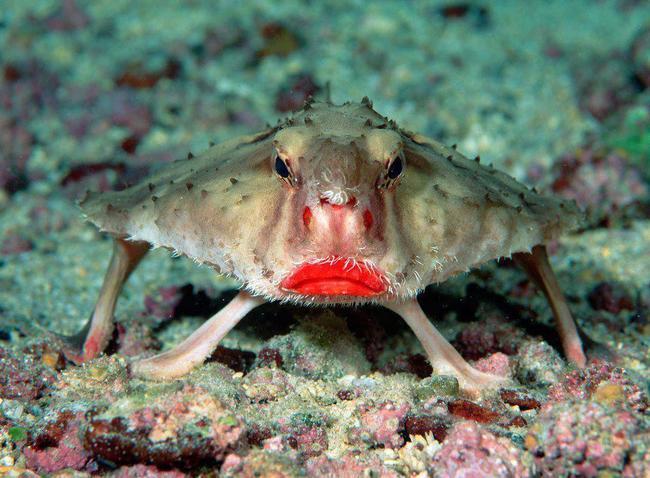
The Red-lipped batfish is also known as Galapagos batfish or Ogcocephalus darwini and is a fish of exceptional morphology. It lives at a water depth of 3 - 70 m around the Galapagos Islands and can also be found off Peru.
The Batfish is a bad swimmer and uses its specially shaped fins just to run around on the seabed. As the batfish has matured, its dorsal fin becomes a single spine-like projection, which may act as bait for prey. Like other anglerfish, it has a structure on its head known as the Illicium. This structure is used to attract prey. As it is hard to overlook, the fish has bright almost fluorescent red lips, to whom it owes a significant part of its name.
Third example: Blue-footed booby
Image Source: Tui De Roy / Minden Pictures
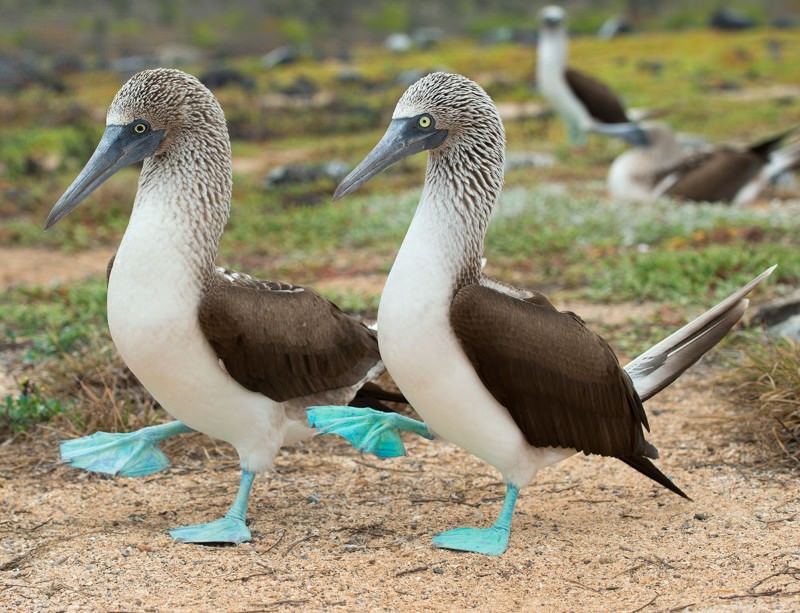
The blue-footed booby is one of six species of the genus Sula, which is funnily also referred to as the 'boobies'. Hence its scientific name is Sula nebouxii. The most striking feature of these animals are their intense blue feet, which are used as a characteristic selection criterion in mating.
In an elaborated mating ritual the male shows his blue feet dancing in front of the female. If she gets on and dances along with him, he is on the road to victory. The dance includes whistling, fluttering and some marching of both birds on their vivid blue feet and can last for impressively several hours.
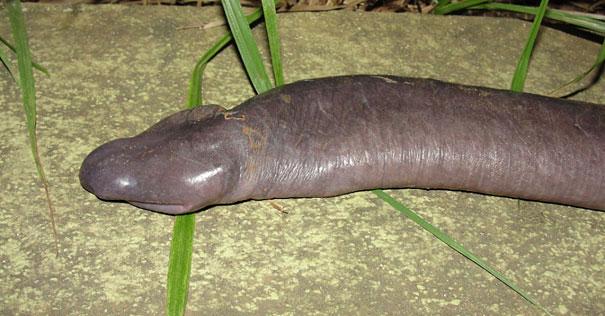
Fourth example: Atretochoana eiselti
Image Source: Juliano Tupan
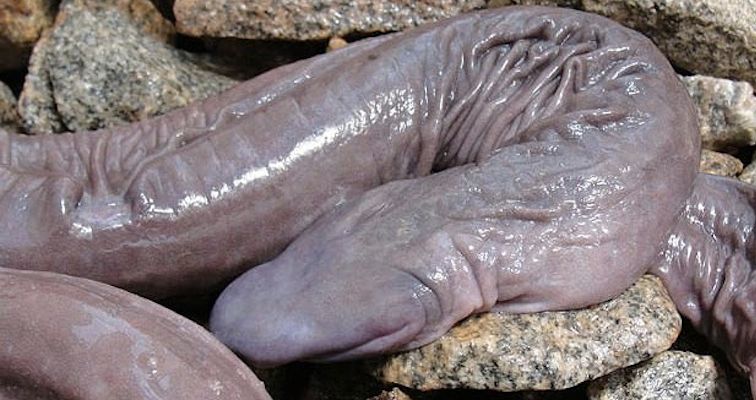
Atretochoana eiselti is a species of Caecilian which is colloquially and comprehensibly referred to as 'penis snake'. It belongs to the monotypic genus of Atretochoana, counts - due to its supposed relationships - to the largest lungless tetrapods and is definitely the largest lungless caecilian.
Caeclians are limbless amphibians with snakelike bodies. The head of this particular species is untypically flat and wide, has mobile cheeks and an enlarged mouth. Only some handful of these creatures have been spotted so far, thus not much is known about them. The IUCN classified this species as 'Data Deficient'.
Due to its morphology and lack of lungs, it was initially thought to be native to cold, fast-flowing waters. In 2011, however, some of these animals were spotted in the Madeira River, which does neither carry cold nor fast flowing water. Both would be prerequisites for a high dissolved oxygen content. This finding makes their missing lungs even more unusual and also the question of how these animals breathe is still unclear.
Image Source: boringduckling
Fifth example: Venezuelan poodle moth
Image Source: Dr. Arthur Anker
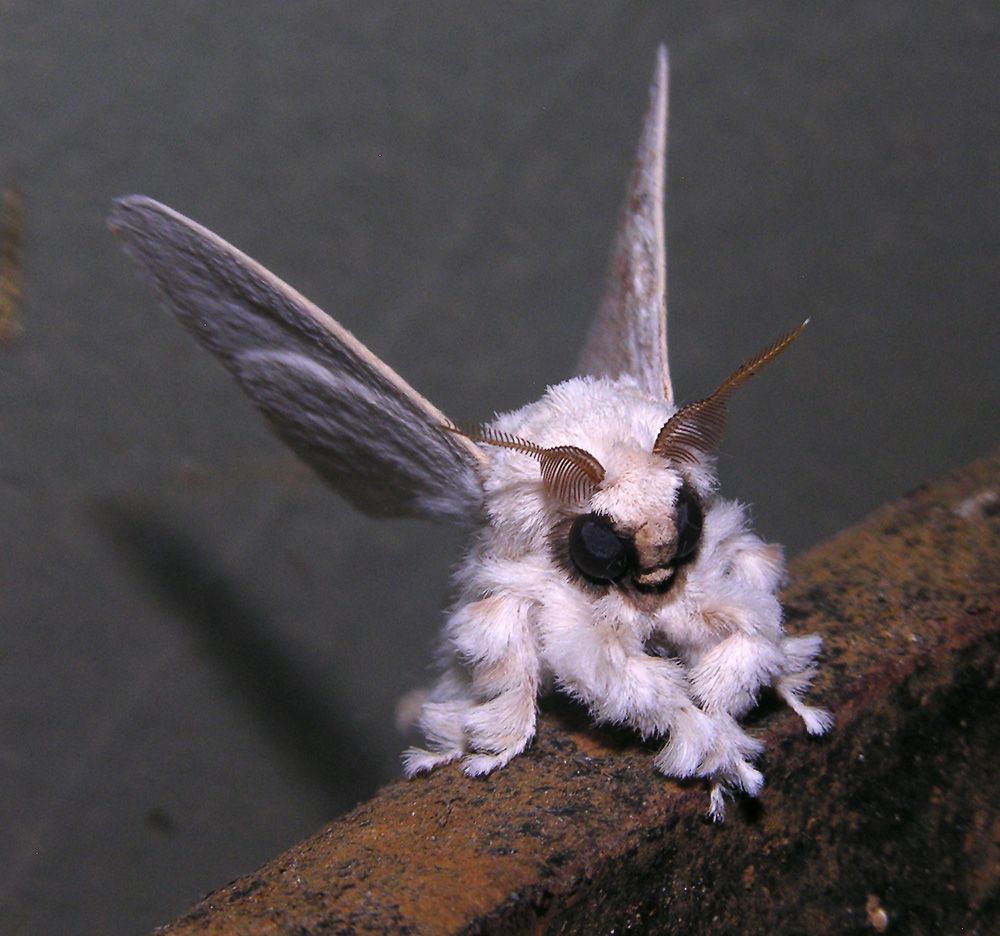
The Venezuelan poodle moth was discovered in 2009 in the Gran Sabana region of Venezuela, and was photographed by Dr. Arthur Anker. It is not clear whether it belongs to a described species or represents a new one.
The attentive reader may wonder why this insect has hair, because insects are cold-blooded and do not have to preserve their body temperature through body hair in order to maintain essential body functions. At this point it is important to differentiate between hair of mammals and insects.
Although they may look similar in appearance, they have completely different functions. In insects the are rather called 'setae' and have functions such as the perception of the environment, the sense of smell or serve as defense mechanisms against hostile animals.
Image Source: pixabay
I hope you enjoyed this collection of curious creatures!
Best,
mountain.phil28
References:
- K. C. Catania "The sense of touch in the star-nosed mole: from mechanoreceptors to the brain". Philos Trans R Soc B., 2011 366: 3016–3025.
- R. Kemeny. Blue-footed boogie isn’t enough for booby babies. New Scientist, 2014
- B. Crew. If only you could see yourself, Atretochoana eiselti. Scientific America, 2012
- Is the Venezuelan Poodle Moth as soft and cuddly as it looks?. ScienceExplained, 2013
- M. S. Hoogmoed, A. O. Maciel, J. T. Coragem. "Discovery of the largest lungless tetrapod, Atretochoana eiselti (Taylor, 1968) (Amphibia: Gymnophiona: Typhlonectidae), in its natural habitat in Brazilian Amazonia". Boletim do Museu Paraense Emílio Goeldi : Ciências Naturais, 2011 6 (3): pp. 241–262.
- Wikipedia Articles on the Star-nosed mole, Red-lipped batfish, Blue-footed booby, Atretochoana eiselti, Venezuelan poodle moth