
Hello my dear Science-Steemians!
After a small illness-related break, I'm back again with an exciting topic:
The Power of API Tuning
Many of the active pharmaceutical ingredients (short: APIs) and their physiological effects used in modern medication have been discovered by accident. In many cases these are substances which have been isolated first from plants, fungi or bacteria.
These substances are medically relevant because they interact with the body, hence they show physiological effects. Such interactions can be exploited to treat physiological incapabilities and diseases. Sometimes the interactions of the substances with the body are not too specific and the patient not only experiences desired effects but also others: side effects.

There are various approaches to minimize side effects, e.g.
Efficient Drug Delivery:
If the drug is administered in such a way that the API reaches the site of action efficiently (e.g. direct injection, gastro-resistant tablet,...) a smaller total dosage of API may give the same therapeutic effect as large ones. This goes hand in hand with a reduction of systemic side effects.Tuning of the API for easy excretion:
Even with targeted local application of drugs, in many cases, absorption into the organism can not be prevented. In order to preclude extensive systemic interactions, an efficient excretion mechanism is necessary.Selectivity Tuning of the API:
In this case, the chemical structure of the active ingredient is altered in order to increase preferential and strong interactions with the desired receptors only, or to allow an enhanced directed transport into the tissue of interest.
First and Second Generation APIs
First-generation substances are those that have been discovered and approved first. Second-generation drugs are structurally often based on first-generation drugs. They are often (not always!) better compatible and more efficient, since API tuning has specifically been done to gain benefits of this type. - But how is this done?
In principle the chemical structure is altered either by a rational or a statistical approach. For example, a rational approach is possible if the 3D-structure and the precise interactions between the API and the involved receptor are known very well. This allows to change the design of the drug in a rational way. Small modifications (e.g. side chains) may change important properties, e.g. a more efficient degradation and excretion.
The variants obtained by the changes are retested and in some fortunate cases show improvements in one or more of the mentioned properties.
Examples
In order to illustrate the dicussed topic, the well-known and powerful group of corticosteroids shall be utilized:
All changes are highlighted in red. - Ref. 2
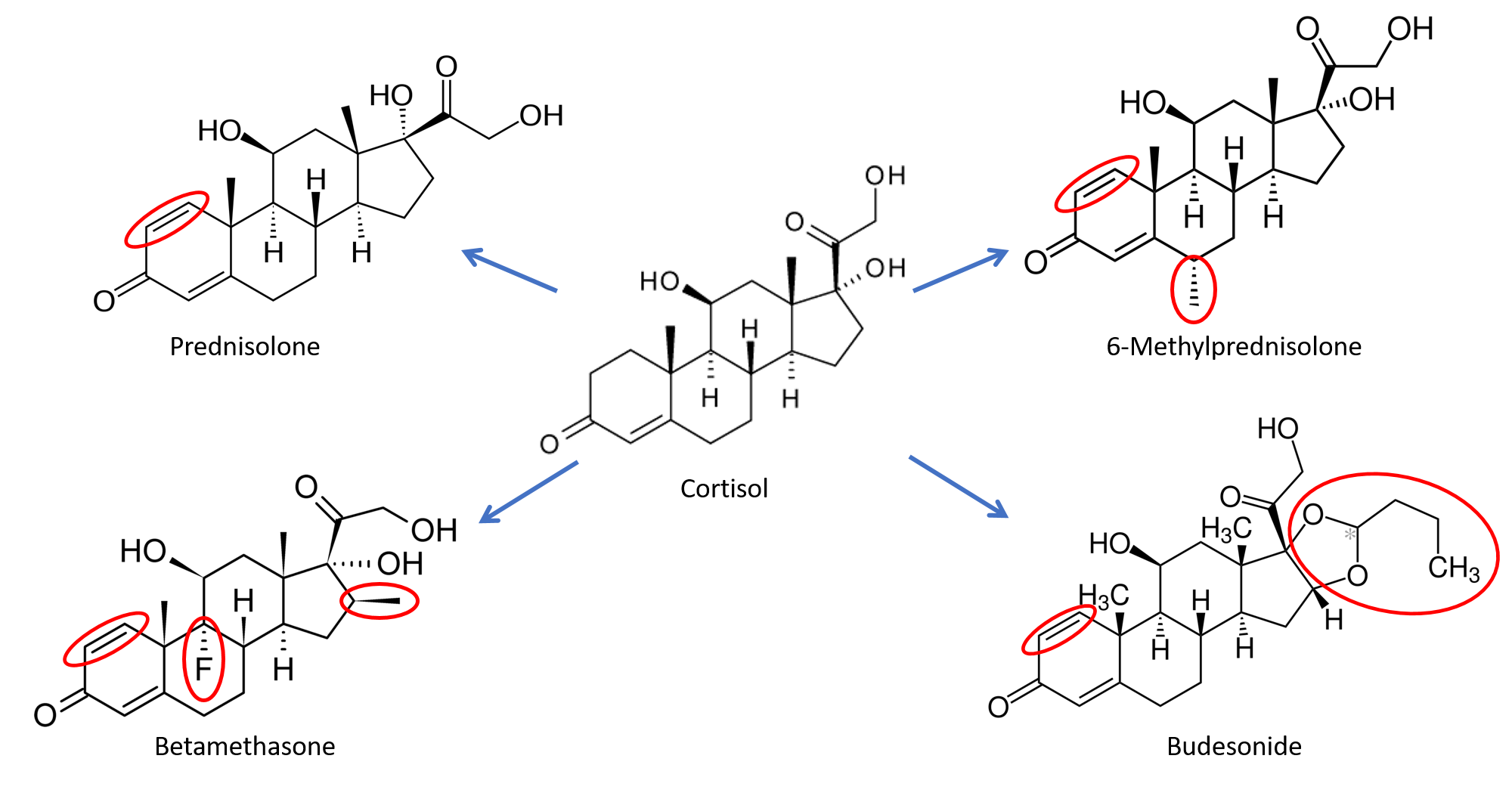
Cortisol was discovered in 1937 and plays a key role as an endogenous hormone in a variety of inflammatory and metabolic processes as also in the water balance. On the one hand this makes it a very potent drug candidate, but on the other it is also quite unspecific and the intake is accompanied by some serious side effects.
Therefore, the API has been modified in different ways to allow better treatment options:
Prednisolone:
4-times more anti-inflammatory, mineral balance hardly affected6-Methylprednisolone:
5-times more anti-inflammatory, mineral balance hardly affectedBudesonide:
highly effective, 90% degraded after the first liver passageBetamethasone:
more stable form, gives higher active concentration, which allows the use of smaller dosages; prolonged use may cause accumulation and then again gives severe side effects
I hope you enjoyed this scientific insight into modern drug design.
Best,
mountain.phil28
References:
- T. Andus, Kortikosteroid-Therapie, 2010, 17th Edition
- Compound images taken from Wikipedia
- Sumeet Gupta, Indian J. Psychiatry, 2010, 52(1), 77.